
In the 1920s, a grieving middle-aged couple, Mabel and Jack, move to the Alaskan wilderness to make a new start. Their cherished dream for a family of their own has shattered under the weight of miscarriages and a baby still-born, and their flight to the wilderness carries with it their hopes for a renewed sense of purpose together.
So begins The Snow Child (published 2012), a fairy-tale retelling of the Russian folktale called Snegurochka, about a maiden made out of snow by an old couple. This was the debut novel from Eowyn Ivey, and what a debut it was! It was a finalist for the Pulitzer Prize and an international bestseller. Quite an impressive feat for a new author!
I had heard about this book for years and meant to read it “some day”, but had forgotten about it until I saw the e-book for sale on my Kindle. I snapped it up and immediately became enchanted with the tale of Mabel and Jack and their snow child.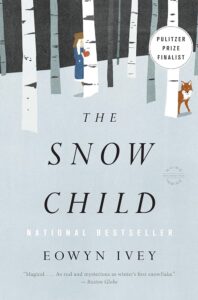
This is a very good book, which should come as no surprise, considering its Pulitzer Prize nomination. The prose is haunting and beautiful, and its exploration of beauty, loneliness, faithfulness and family lingers after the book is done.
But it’s also just a good story, with characters to care about and a haunting mystery that keeps you turning the pages.
It’s been awhile since I highlighted so many passages in a book, but right from the beginning, Ivey’s beautiful descriptions of the Alaskan wilderness kept making me stop and linger over the sentences. Such as,
The sun was setting down the river, casting a cold pink hue along the white-capped mountains that framed both sides of the valley. Upriver, the willow shrubs and gravel bars, the spruce forests and low-lying poplar stands, swelled to the mountains in a steely blue. No fields or fences, homes or roads; not a single living soul as far as she could see in any direction. Only wilderness.
It was beautiful, Mabel knew, but it was a beauty that ripped you open and scoured you clean so that you were left helpless and exposed, if you lived at all.
Mabel is trapped. The challenge of rebuilding a life in a harsh new land has almost broken her, and has almost broken her marriage to Jake. They are going through the motions, unable to express their grief over their fading dreams and lost children, consumed with the necessity of survival in this spare and unforgiving land.
As the book opens, their second winter is approaching, and Mabel is almost at the end of her rope. The long, frigid darkness is fast approaching, and she is dreading the silent months to come where she is alone in the cabin while her husband struggles to keep their animals (and them) alive.
The book switches POV between Mabel and Jack, so we get a sense of what this grim struggle is like for both of them. For Mabel, her hopes of building this life together with Jake are crumbling. Jack insists on doing the work alone, shattering her dream of working side-by-side to create something new. She is left with her grief and her loneliness, and, without purpose, begins to think she has nothing at all to live for.
Jack is consumed with keeping them both alive, a task that he is quickly realizing is beyond him. Doing the work on his own is too much. And the land is unforgiving. It’s difficult at the best of times to clear land, plant crops and vegetables, keep chickens laying eggs and food on the table. Those tasks are doubly hard in the vast wilderness they find themselves in, and triply hard when he is doing the work by himself. Especially since he is no longer a young man. Yet he refuses to allow Mabel to help in the fields or with any of the hard, physical labour. Partly it is because he wishes to spare her, but also his pride and sense of manhood insists he do it himself. And deep down, he doesn’t want her to know just how difficult this life she insisted on embarking on is. He sees her fading, but he doesn’t know how to help her, because he knows the one thing that she wants he can’t give her. A family of their own.
Mabel contributes to their survival by baking pies for the railway station, which Jake takes weekly on his trip to the small collection of buildings that make up the small town of Alpine that has built up around the station. But a crisis is looming – the stationmaster’s wife no longer needs the pies as her sister is coming to stay with them and she will earn her keep by making them.
This is a huge blow, as Jack and Mabel were relying on that income to get them through the winter. The only option seems to be for Jack to go further north and work at the mine, a dangerous, difficult job which would leave Mabel completely alone in their cabin for weeks at a time in the depths of winter.
But another homesteading family, who live some miles away on the other side of the railway station, come to the rescue – literally and figuratively. George insists on coming with his teenage boys to help Jack clear some land, and, more importantly, hunt for a moose that would provide them some food over the winter.
Mabel is not happy about this. Lost in her sadness and her determination to hide away from people, nursing her losses and the shame of being unable to have children, she wants their world to consist of just the two of them.
Jack might need help this particular day, but they were not in need of friends or neighbours. Otherwise, why had they come here?They could have stayed home, where there were people enough for anyone. No, the point had been to find some solace on their own. Hadn’t Jack understood that?
Reluctantly, Mabel allows that they will visit George his family for Thanksgiving, and this brings Esther into her life, a larger-than-life no nonsense woman with a kind heart, who lives life on her own terms.
Soon after this visit, a magical, snowy night rekindles Mabel and Jack’s sputtering relationship, and, on a whim, they create a snow child, a young girl festooned with Mabel’s mittens and scarf.
The next day, the snow child is gone, and small footprints lead away from the discarded mittens and scarf on the snow.
The story expands from here, tracing the mystery that baffles them as they slowly fall under the enchantment of the child that skitters in and out of their life on snowy winds, bringing hope to a couple who have almost lost it.
This is a beautiful, haunting story. I love the characters. Ivey paints their struggles in such honest terms that you can’t help but ache with them both. They clearly love each other, but they are both so wounded in different ways by their childlessness that it has become a mountain in their path that threatens to crush them.
I love seeing them come to life again as they welcome the snow child into their lives, but that also opens them up to more heartbreak, for, of course, loving a child who will eventually leave you is not always easy.
I also loved the setting. Ivey deftly captures the Alaskan wilderness in all its glory and harshness in her prose. Which makes sense, because she, herself, is a native Alaskan, and she still makes it her home. You can tell that she understands what it is like to live in there. Too often I see TV shows or movies which don’t truly capture what the long, dark days of winter are like in the north, nor the beauty that can come on a dazzling winter day. Ivey helps us to understand, and experience, both. You might want to curl up with a warm beverage and blanket to read this one!
This is a stellar read. I really enjoyed it and highly recommend it. Five stars from me!
Enjoy historical fantasy novels? Why not take a look at my trilogy, set in 7th century England, featuring a young man whose accidental trip back in time has ominious consequences both for him and the world he is desparate to return to.

Clcik on the image to learn more!