As I embarked on my Very Long Walk Through Spain, one of my important packing decisions involved what books to bring. Fellow voracious readers will understand the complexity of that decision! Fortunately, we now live in an era where space/weight is not an issue. Thank you, God, for whoever it was who invented e-books! The issue becomes more of substance.
A long and weighty walk perhaps needed a long and weighty book? But did I want to get bogged down with ideas or wrestle with deep theological or philosophical arguments after a long day of walking? The spirit might have been willing, but I suspected the body might be weak. But perhaps I could handle a long and weighty fiction book, no?
As it happens, I knew just the book. R.F. Kuang’s Babel: Or, the Necessity of Violence, had been on my radar ever since I saw her being interviewed a couple of years ago. She framed it as “being in conversation with Susanna Clarke’s Jonathan Strange and Mr. Norrell“. Of course, I had to read it.
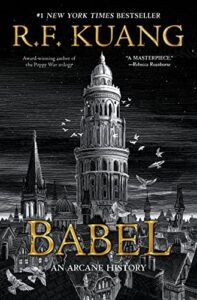
I love the cover. Captures the “dark academia” genre perfectly.
So, as I began my steps on the Camino towards Santiago, I also began a journey into Kuang’s alternate-history world of 1830s England, where magical silver bars fuels its global dominance. The magic is based on language translation. Silver-workers carve two words meaning the same thing in different languages onto the bars, and the dissonance of what is “lost in translation” creates the magic.
The plot revolves around a cohort of four young adults who enter the Royal Institution of Translation in Oxford (nicknamed “Babel”) in order to work on the translations needed for silver-working, with the goal of eventually becoming silver-workers themselves. Their growing understanding of how Britain uses its superiority to create and produce these magical bars to control and dominate the rest of the world, and their growing discomfort of their part in this process, is what keeps the story moving.
The main character is an orphan from Canton who is rescued by a Babel professor, Richard Lovell, and given the English name Robin Swift. Lovell raises Robin in his home in Canton and tutors him in English and Latin. He also encourages Robin not to lose his native tongue of Mandarin and also gives him lessons in that language, as Lovell is a fluent Mandarin speaker. But this is a loveless childhood. Lovell treats Robin more like a boarding school pupil than as a son. In fact, Lovell hides him away whenever he has English visitors to his home and never publically acknowledges Robin as his son. This is even more galling when it quickly becomes apparent that Lovell is, in fact, Robin’s biological father. Robin is brutally beaten when he embarrasses Lovell by being late for a lesson one day, and is reminded constantly of how fortunate he is to be rescued from a grinding life of poverty, where he could hope for nothing but an early death.
Despite his difficulties, or perhaps because of them, Robin excels in his studies and is admitted into Babel, where he meets the other members of his first-year cohort: Ramy from Calcutta, Victoire from Haiti, and Letty, a white British admiral’s daughter. They learn the effectiveness of translating European languages into English is quickly fading, as most of those words have been used and re-translated many times. Other languages, such as Creole, Mandarin, Haitian, and Arabic, are considered the new frontier in language translation magic. Hence their presence at Babel.
Robin and his friends quickly form a tight bond, partially because they share the ups and downs of being first-year students, but also because they are the only non-white students at Oxford and are constantly bumping up against English society’s hidden and overt racism. However, they all set their minds to their studies and exist in a happy fellowship that comes from a group of people discovering new ideas and working hard at them together.
But it’s not completely happy. Clouds that mar the sunshine soon blow in. Robin and his friends are increasingly forced to confront the role that Babel plays in the subjection of the colonies, and wrestle with their part in this evil. Robin faces difficult choices when his previously unknown half-brother Griffin approaches him. Griffin is also Lovell’s son and another former Babel student, who disappeared under a cloud of suspicion. He invites Robin to join a secret society whose aim is to undermine and eventually destroy Babel itself.
The plot spirals out from there, following Robin and the cohort as they seek to navigate through this world that both needs their expertise and exploits it, and which never accepts them fully.
There is a lot to like about this book. The world building is solid, with one glaring exception, which I will mention later. Babel comes alive on the pages, and the intense trials and joys of academia are well-crafted. The relationship between the friends is engaging, making you care about them and their choices. Making this an alternate-history book by adding the silver-working magic system added extra interest.
However, there are some elements to the book that ultimately turned the reading of it from a delight to a chore.
The magic system – I loved that Kuang came up with this utterly unique system of magic based on the translation of one word to another. Fabulous! But, honestly, I never really understood how it actually worked. There were some explanations for it in the book, but I didn’t quite get it. Which could have been fine. There are plenty of other magic systems in other fantasy books that I have read where the magic system is a little fuzzy. It’s “magic”, after all. I can live with a little fuzziness. However, this was the point of the spear that cut a big hole in the book for me.
Alternate history fail – this issue was a bigger one for me, but it is tied to the first. Kuang sets up a world where England has risen to power on the backs of the silver-working magic. Ok, fine. But why don’t any other countries use this power, too? Kuang addresses this in the book a time or two, but, like the explanations she gives for silver-working, they fall flat. It basically comes down to, “Well, they tried, but it didn’t work as well.” Or, “They didn’t apply themselves to it like England did”, or “England took all the silver.” Really? So everyone just accepts that there is a remarkable power that can enhance every object you have (adding a silver-worked bar to a train can make it run faster and more efficiently, for example) but no other country is going to rival England in using it? Everyone else in the world is too lazy or too dumb to figure it out? There are no “silver wars” for control over this marvellous resource? Hmm. The result of all this is that Kuang gives us a world that is exactly like our world and history that follows exactly the same as our history does, except for this magical element added in. This is a hard trick to manage, and on the whole, it’s one that she fails at. It’s like urban fantasy books that present a world exactly like our own, but with werewolves and vampires added in. Any chaos caused by those creatures is explained away by “Well, regular people just don’t want to see it because to acknowledge it would be too scary,” or by a super-secret organization that suppresses or controls these outbreaks so that they always have a “rational” explanation. But at least those two types of explanation work better than the ones that Kuang presents in her book.
Lecturing, lecturing, LECTURING… I don’t believe that Kuang never thought through the implications of her magic system on the “real world”. I’m sure she did. But it seems to me she didn’t want to show any other countries challenging England’s supremacy over silver-working because this would distract from the main point of her book: COLONIALISM IS VERY BAD AND VIOLENCE IS THE ONLY WAY TO NEGATE ITS EFFECTS. I put this in all-caps because I felt pretty bludgeoned by this point by the time I finished the book. In the first quarter of the book, Kuang does a superb job of giving us subtle hints and thought-provoking scenes in which Robin’s plight as an orphan thrust on the mercy of a stern and creepy benefactor was well-drawn out. We clearly saw racism and arrogance on display, giving us sympathy for Robin and opportunities to reflect on our own attitudes towards others different from ourselves. However, this all changes once Robin gets to Babel, and it gets worse and worse as the book continues. We are treated to endless moralizing speechifying by one character after another about the evils of colonialism and its nasty twin brother, capitalism. This annoys at first, and then, as the floodgates open and the reader is increasingly drowning in these pronouncements, they become tired of being bludgeoned and just want it all to be over. At least that was the experience of THIS reader.
This also speaks back to my second point above, that of an alternate history fail. How many people in the upper classes of 1830s England made any kind of notice or had any kind of discussion about “colonialism”, using that particular word? I’m going to guess NONE. For example of this, towards the end Robin says,
“This is how colonialism works. It convinces us that the fallout from resistance is entirely our fault, that the immoral choice is resistance itself rather than the circumstances that demanded it.”
“Colonialism” as a concept as it exists today, gathered up into that word, was not even around at that time. Not that people in the 1830s weren’t wrestling with what we now call “colonialism”. But they had their own words and concepts to express it. So, why not use those words and concepts? All of her careful world-building around Oxford and 1830s England gets tarnished as a result of her insistence to frame this discussion with modern-day words and concepts. Which is odd, seeing that translation itself is based on choosing the right word.
I’m not the only one who noticed this. Babel was released to mixed reviews. Many of the negative ones mentioned this very thing as well, such as the review by Publisher’s Weekly:
The narrative is frequently interrupted by lectures on why imperialism is bad, not trusting the reader or the plot itself enough to know that this message will be clear from the events as they unfold. Kuang assumes an audience that disagrees with her, and the result keeps readers who are already aware of the evils of racism and empire at arm’s length. The characters, meanwhile, often feel dubiously motivated.
Finally, a note about Jonathan Strange and Mr. Norell (JSAMN). Kuang states that she wrote Babel to be in “conversation” with Clarke’s book. I suppose she means that her book is showing an entirely different side of the 1830s imperial England that is displayed in Clarke’s book. Like JSAMN, Babel is festooned with footnotes. In JSAMN, the footnotes support and enrich the text, giving the alternate history world real substance. But in Babel, the footnotes only continue the lecture and badgering. As one Goodreads reviewer put it, “these notes tell us that the racist things that racist characters say are, in fact, racist…”. It’s also strange that these footnotes, referencing real-world history and people, are written in Kuang’s own voice. This is unlike the footnotes in JSAMN, which reference entirely made-up works supporting the alternate history world Clarke displays in her book.
I like the idea of one book being in “conversation” with an another. I just wish Kuang would have had this conversation in normal tones, not with a megaphone turned up to max. And, by the way, if she is trying to say that JSAMN centers around white men and ignores the racism and evil of that society, she must not have read the end, where [SPOILER ALERT] it is, in fact, a Black man, a child of a slave, who ends up being the most important person of all. And that part of the wonderful subtlety of JSAMN is that it shows how these supposedly educated men really had absolutely no clue about what they were messing with or what was really important, and that there are powers in the world that trump their puny attempts to be in control.
I really wanted to like this novel, and there are parts of it I really did like. But I got weary of the preachy tone and, in the end, found it an unsatisfying read. I’ll give it three stars.